Back in 2012, Isolde and I recorded a conversation entitled ‘Tales of Sheebeg’. It was a topic that was very close to my heart. Sheebeg, after all is the hill on which I live. It is a hill with an extensive and beautiful view. The Corry hills and Sliabh an Iarainn, The Iron mountain frame the horizon and patchworks of pastures and lakes form the foreground. I think that was when I first opened that gate, so close to the peak of the hill, that lead down to the Shanraw house, I knew this was where I intended to live. I have never regreted it.
When Isolde and I recorded ‘Tales of Sheebeg’, sixteen years ago, we shared all the local legends of the Sheebeg landscape and, especially everything we knew about the unofficial dig that took place in the winter of !930/31. The cairn on Sheebeg is fairly typical of the neolithic passage tombs found on the high places in the north west of Ireland. Perhaps the best examples can be found on Carrowkeel but there are also three, on Sheemore although time hasn’t treated them so kindly.
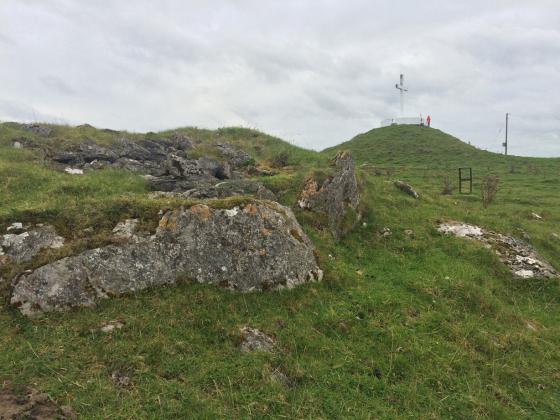
What was unique about the 1931 unofficial dig on Sheemore was that skeletal remains were found. These were brought out and were said to be the bones of a man and a woman and as there were legends (probably from the eighteenth century) concerning Finn or Find mac Cumail, these bones were considered to be theirs. The tales from neighbours, and relatives who were involved or recalled the event generally suggested that they had the bones been replaced inside the cairn before it was resealed. It was unlikely that the cairn would be reopened.
The stories from the time implied that fairly complete skeletons had been found This led me to wonder if they might have been from the Iron age rather than neolithic. Iron age insertions had, occasionally been found in passage graves. If I remember correctly, I think bones of this age had recently been uncovered at Carrowmore. It was, of course, as I said at the time, pure speculation but I did construct a ‘fantasy’ about an Iron age local chief buried in an honoured location. It was just a story but I suspected at the time, that we would never know for sure as the bones, it seems, were lost.
How wrong I was! Last week I was sent news of the results from a very exciting project. New Light on Old Bones a project organised by Dr. Niamh Daly and Professor Peter Halligan. From what I have read in the Archaeology Ireland article, it seems that, in fact, partial skeletons including skulls, mandibles, teeth ribs and shoulder blades were originally found in the passage tomb and that, something I hadn’t heard locally, that the slanting angle of the remains suggested that they were buried in a reclining position.
Now It seems that some bones taken from the cairn in 1931, two mandibles and a bag of teeth, were taken to Dublin before the amateur and unauthorised dig was closed down. Maybe it was the other bones that were put back. But whatever happened back then, in 2024, the bones and teeth held by the museum were retrieved and the new project sought to have them re-examined and dated.
The project won the Leitrim County’s top Heritage Week award for 2025 but the big news now concerns the exciting findings on the remains. There were, indeed two adult mandibles probably those of a man and a woman. The local tales seem to have been correct on that point. However, it was concluded that the total assemblage contained the remains of at least three adult individuals.
But I have to admit my highly speculative story was way out. The remains were dated to 3633-3383 BCE. That means that these individuals were buried in this passage tomb, in the early part of the Middle Neolithic around 5,600 years ago. This is very exciting and largely fits current understanding of Neolithic settlement in the West of Ireland. To quote the article in Archaeology Ireland, “Using absolute dates, the remains at Sheebeg compare well chronologically with other major local passage tomb complexes in the north-west such as Carrowkeel/Carrowmore but are somewhat older than Newgrange (3300-2900) or Knowth (3160-3000).“
The article goes on to conclude, “Future studies will need to clarify the relationship with other passage tombs in the locality, particularly those at the Sheemore, Carrowmore and Carrowkeel passage tomb complexes.”
Since I moved here in 1990, I have always hoped to find out more about the cairn but as the current land owner once said to me, ‘Perhaps some things are better left a mystery.
Back in 1931 Prof. Macalister decided not to visit the site to inspect the cairn and excavation to ensure that all the artefacts were properly collected and confirm that the excavation had been closed. Perhaps that was unfortunate, and yet now when there are so many modern archaeological tools that can be so effective in opening ‘windows’ on the distant past I, for one, am delighted and very grateful to the organisers of this brilliant local project. I do hope to be able to arrange a Stories in the Landscape Conversation on this topic before very long.
Further Links
- Archaeology Ireland The article can be found in the Spring 2026 edition
- Irish Independant report on the project.
- Tales of Sheebeg: The 1931 excavation
- Tales of Sheebeg Podcast episode from 2012
