Among the generally agreed ideas about early settlements in Ireland were that you wouldn’t expect to find hill forts, as might be found located in the Uk or on the continent and that the first permanent towns were introduced by the Vikings.
However, some recent archaeological research has changed all of this. On the 8th January 2026 a report in the Irish Times was headed:
“Largest and oldest prehistoric ‘proto-town’ identified – long before the Vikings showed up.”
The same report was covered by the Irish Independent, RTE and the BBC among other news outlets. So, this was something new, something surprising and something important.
The report covered archaeological research and survey reports, gathered over a couple of decades, from a site in South West Wicklow known as the Baltinglass hillfort Cluster. A study led by Queens University Belfast has indicated that a settlement at Brusselstown Ring may have been part of what could have been far more than a temporary collection of dwellings. This site may represent a proto-town predating the Viking settlements by a couple of millennia!
I can best describe how exciting this is by quoting from the Queens University webpage.
The Queen’s-led study carried out radiocarbon dating which suggested occupation at Brusselstown Ring during the Late Bronze Age, between c.1210 and 780 BC – many centuries before the Vikings, normally credited with having founded the first towns in Ireland, arrived on the island – with continued use or re-use of some house platforms up to the Early Iron Age (c.750–400 BC).
Terrestrial survey work carried out within the past decade at Brusselstown Ring had detected 288 potential hut sites, but aerial surveys from 2017 and 2022 identified more than 600 topographical anomalies consistent with prehistoric house platforms.
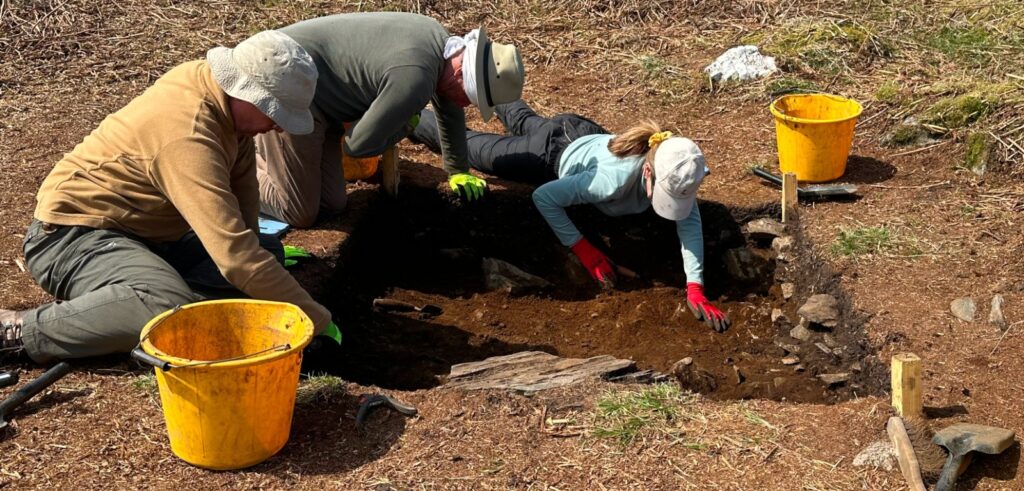
The Queen’s University-led project combined existing data with the results of its own ground excavations to locate 98 potential roundhouse footprints within the inner enclosure, with a possible further 509 between the inner and outer enclosing elements.
Queens University Belfast
Recently a topographical anomaly has been discovered which may well turn out to be a water cistern. The report states that this appears to be consistent with Iron and Bronze Age cisterns from other parts of Europe. Now that would be exciting.
What I find particularly interesting about this report is that it does demonstrate a definite level of organisation and cohesion in late Bronze age society and continuity on into the later early iron age.
I would very much like to find out more about this new research and hope to make it the topic of a Stories in the Landscape conversation before long,